



Market entry Services
The imponderables in entering new markets with different conditions, may deter businesses from expansion.
The trends in Global Trade, FDI and the changing dynamics between the traditional trading partners over the last three decades have provided a pivot for further and larger shifts in the trading and investment equations of countries and regions. Prime example, are the altering equations between the developed and the emerging economies.
While the reasons may be several for these changing realities, the direction and disruption in markets will continue to be impacted by Costs, Skill availability, Trade Policies, Technology, Geo-Politics, Equity flows, Taxation regimes, factor-price differentials, innovation absorption.
What works well in one place may never work in another place.
While some global companies tailor different product offerings for different geographic locations, others pursue a global strategy, selling the same product worldwide.
We provide a bridge across such challenges with services along the Strategic, Execution and Governance life cycle.


 Benefits of Going Global
Markets and consumers are connected. Concepts cross borders long before businesses do. Every day an increasing number of products move half-way around the world, either by air or sea, into the hands of consumers who have never visited the country of origin.
Businesses do not have boundaries – only barriers, real and unexplored.
Businesses which limit themselves geographically, may somewhere surrender market share or competitiveness to others. It therefore makes great business sense to explore and expand globally. We need to constantly evaluate and calibrate both opportunity and risks from Macroeconomic, Strategic and Operational indicators and issues.
To even stay where one is – a business will need to move and maybe move beyond borders.

Key Benefits Of International Expansion
The United States has roughly 4% of the World’s population, India has 17%, China has 19%, and Southeast Asia has 9%, Africa has 15% (these are all growing every day).
And it’s not just the populations of these growing economies that are rising – their GDP per capita is too. The USA currently holds about 1/3 of the World’s purchasing power. But the centre of gravity in consumption maybe changing fast, as a consumption driven middle-class is growing in the rest of the World.

About 80% of the 80B workforce is in the emerging markets. The opportunity also is in assessing where is the greatest potential to go from untrained to trained, for global standards.
International expansion allows access to greater numbers of highly educated professionals, skilled workers, and unskilled labourers.

With a planned leveraging of resources and markets businesses will be able to drive only the number of potential consumers of their product or service, but may also be able to extract higher margins in both the old and new markets.
When exporting products, the costs will undoubtedly change, but it’s been shown that consumers in developing countries will pay-up for access to high-quality and well-branded products.
 ">
">
It’s no secret that economies of scale are what made the largest companies of this era. An increase in output via international expansion is often with lower variable costs.
The importance of this is three-fold:
- 1. Increase in margins.
- 2. Offset exporting costs with decreased production costs.
- 3. Keep prices more competitive in the home country.
 ">
">
Iterate faster to create better products. Exporting products will instantly expose them to consumers with different needs, tastes, opinions, and ways of interacting with the world around them.
The knowledge gained will serve your company well – either by providing new insights about your current domestic offerings or sparking ideas for new products that can serve both markets.
 ">
">
International expansion will soon be standard operating procedure for all, even the smallest of ventures, depending on their product application, markets and distribution.
Around the turn of the 21st century, it was the only the forward-thinking company that had an online presence. It was unheard of for all but the largest companies to sell products online. Now almost every company has or plans to have some kind of online presence.
The next wave of commerce is here – and it’s going overseas !.

 Market Entry Services
The decision to operate in a new country market can be an onerous task to plan and execute. The range of factors to consider, data points to interpret and networking required can well derail the process, in the absence of experts and help.
Whatever the objective of engaging with a new country may be – for costs or revenues; there are complex decisions to be made. From simpler trading decisions to more complex forms include truly global operations which may involve joint ventures, or export processing zones. These requirements are from a process which encompasses several stages to entry planning and execution. These stages require several skills, competencies and experience.
We help you arrive at your decisions and then execute them. We then go on to provide operational, management and governance services in the running of the business.






 Global Value Chain Services
Currently GVC’s contribute around 30% & 18% of the GDP’s of Developed and Developing countries respectively.
It is in the 1990’s that the term GVC came into popular use. Pre-production, Production, Post Production, trade and investments are increasingly organised within Global Value Chains (GVCs) where the different stages of the production or fulfilment processes are located across the world.
Businesses try to optimise their processes across the various stages over different sites with the global distribution of activities such as design, production, marketing, distribution, services etc.
The strategic unbundling of processes, into a Value Chain is amongst the first steps companies need to consider.
Our experience helps you to develop a competitive advantage around operational excellence and execution.
Key Benefits Of IGVC Services
You may be looking your Global Value Chain or Overseas Captive Centre for one of the following:
- Drive for Product Differentiation .
- Build sustainable Cost Leadership.
- Market Access Models
A logical next stage of Off-shoring is market access into and around the geography the value chain process. We work with you depending on the purpose, scope, model and governance of out sourcing or off shoring depends on the company’s evolution stage and well as the state of development, competence and wage comparisons at the off-shored location.
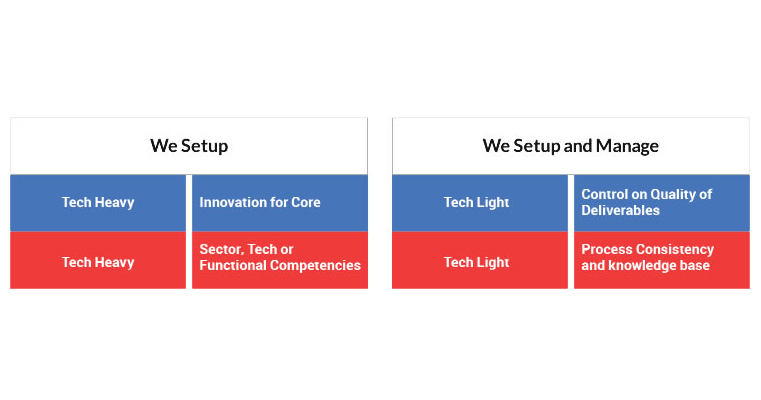

We would set up and manage * Captive Centres or Out Sourced Capability with IT Based processes. Our focus is on delivering quality oriented engagements where we work with you to redesign and deliver on a strategy and process to build positions of strength and measurable progress.
The processes may be around:
- Data and Information Management
- Customer Response or Customer Management Activities
- Learning Development and Management Processes
- HR and Employee Management Process
- Finance & Accounting Processes
Our experience helps you to develop a competitive advantage built around operational excellence and execution as key attributes for any company in any industry.

1. Time and Material
Best suited for flexibility on projects where the scope, specifications, deliverable and implementation plans are not completely defined but expected to evolve over the period of the engagement. Allows for:
- Ramp up and ramp down team size in synchronization with the needs
- Adapt to evolving requirements
- Get detailed visibility and control over the development process
2. Fixed Price
Best suited for projects where the scope, requirements and deliverable are clearly defined before the initiation of the project. Allows to:
- Limit scope variance, control costs and operate within a specified budget
- Get clear visibility on time-lines and milestones
- Reduce your risk and transfer responsibility for the project deliverables
- Expect on-time on budget deliveries provided there are no changes to scope

In this case our team functions as an extension or replacement of your development team and offers you the benefits of:
- Increased development bandwidth for meeting market and customer needs rapidly
- Outsourced project management, establishment of best practices in development, maintenance and support activities
- Having a flexible team that builds knowledge regarding your application and products that you can leverage over a longer period of time
- Lower development and support costs
Captive Development Centers can be Hybrid or pure Offshore.

We operate with an onsite - offshore hybrid team where our Business Consultant or Lead Architect works at your location, in close collaboration with your nominated Project Manager, over an extended period of time, and coordinates with our offshore team. The model:
- Reduces the time needed from your team to coordinate tasks and write business specifications
- Allows you to extend your day and realize greater productivity and faster results
- Helps you manage offshore and outsourced work quickly and easily since some tasks with tighter deadlines or that require close discussions with your team can be accomplished by the Trigent onsite consultant

We work with you to manage your entire SaaS operation on an outsourced model. While you concentrate on strategy, marketing, sales and customer satisfaction, we can help you:
- Migrate and Manage your SaaS software
- Manage your PaaS hosting services provider
- Manage business processes and day to day services operations in your company such as research, development, CRM, Tech Support, Billing and Accounts Receivable management
- Work with you to maximize your revenue model, offer customer satisfaction establish SLAs and manage change within your organization during the transition to SaaS

India Office:
H - 18, First Floor
Greater Kailash - 2
New Delhi, India-110048
US Office:
Varco Global Solutions
P.O.Box 382
Westford, MA-01886
India: +91 9818 922 228
+91 11 4143 7802
US: +1 978 692 6361
Email us:
sales@varcogs.com
business@varcogs.com

@ 2016 Varco Global Solutions. All Rights Reserved. Privacy Policies